
Blockbuster Rewind
A physical, social reimagining of Blockbuster Video — designed, built, and run as a live pop-up for an MS in HCI physical prototyping course.
Role
Research, Set & Hardware Design
Team
5 people · 5 weeks
SUMMARY
Reviving a Dead Brand as a Place to Hang Out
Blockbuster didn’t need to come back as a rental chain — it needed to come back as a place. Blockbuster Rewind reimagines the brand as a third space: part movie theater, part trivia night, part living room, threaded together by genre-based trivia games and free to wander in and out of.
My team and I designed, fabricated, and ran it ourselves as a live pop-up for our physical prototyping course.
My contributions…
Researched third spaces to shape the room’s flow, food-and-beverage needs, and a self-serve “browse the shelf” moment for people not ready to jump into a game
Designed and hand-built the cardboard-and-foam enclosures housing each micro:bit trivia buzzer
Helped shepherd the concept through ideation, including the pivot away from our original VHS-activated movie booth
CONTEXT
A Brand With Nothing Left to Sell, and a Lot Left to Give
Blockbuster doesn’t get to be a video store again — the DVD is gone and it isn’t coming back. But what people actually miss was never really the disc. It was going somewhere on a Friday night with people, browsing shelves next to strangers, arguing about what to watch.
For a five-week physical prototyping course, five of us asked a simpler question: what if we designed for that feeling instead of the transaction?

Our original idea…
A private booth for movie-watching. Step in, insert a VHS tape into a custom player we built, and the lighting would react as the film played.
Outside the booth, micro:bit trivia and a public screening the crowd voted on with sound.
A great idea for a demo table. Not for a room full of strangers on a Friday night — we let it go, and the room we built instead was better for it.
ACCESSIBILITY
A Constraint That Shaped What We Rejected
The project prompt put a real weight on accessibility, and it wasn’t a checkbox exercise — it directly ruled ideas out. Our original VHS booth, for one, was a sealed, dim, single-person space with no easy way to accommodate someone who needed a companion or extra light. That alone was part of why we let it go.
Vision
The Game Master announces each question and its answers twice. Buzzers signal with sound, players get to practice pressing the button before a round starts, and Floor Attendants are there to assist however someone needs.
Rest
The room offers quiet gaming areas set apart from the trivia games, with Floor Attendants mediating if things get loud. Different seating types let people take a break on their own terms.
Hearing
The screen displays every question and answer option and highlights the correct one. The Game Master pairs visual cues with speech to signal turn order, and entrance, check-in, and concession all have legible signage.
RESEARCH
What Makes a Room Worth Walking Into
Third spaces succeed or fail on things that have nothing to do with the main event. I researched third spaces — cafés, arcades, game stores — to figure out what a Blockbuster hangout needed beyond trivia.

What the research shaped…
Food and beverage weren’t optional — a third space without a snack counter reads as an event, not a hangout
The room needed a flow: check-in, into open floor, past themed trivia booths, toward concession and a quieter corner
Not everyone wants to compete — a shelf of old movies to browse solves for the person standing alone who isn’t ready to join a group
We also built four personas — from the Movie-Fanatic who’s there to win, to the Nostalgic who just wants to reminisce — and used them to argue for two very different needs sharing one room: people who wanted to compete, and people who just wanted to be there.
PROTOTYPE
From Cardboard to a Working Buzzer System
Every trivia buzzer in the room was a micro:bit inside a hand-built cardboard shell — a laser-cut window for the micro:bit’s screen, a punched hole for the button. We tested foam as an alternative along the way; it felt nicer in the hand, but cardboard held up just as well, was faster to iterate on, and let us paint and brand it. I designed and built the enclosures.


It had to survive a room full of strangers pressing it as hard as they could, for hours straight — a very different design brief than a button meant to live on a desk.
SHOWCASE
We Built It, Staffed It, and Ran It
We ran Blockbuster Rewind as a live event in the SVC Student Lounge — full staffing plan, a working trivia system, and a room people actually wanted to spend the night in.
Who it took to run the room…
One Game Master ran the trivia interface and kept contestants moving
One Concession Attendant kept popcorn and snacks flowing
Two to three Floor Attendants kept the room running and pointed people toward what to try next
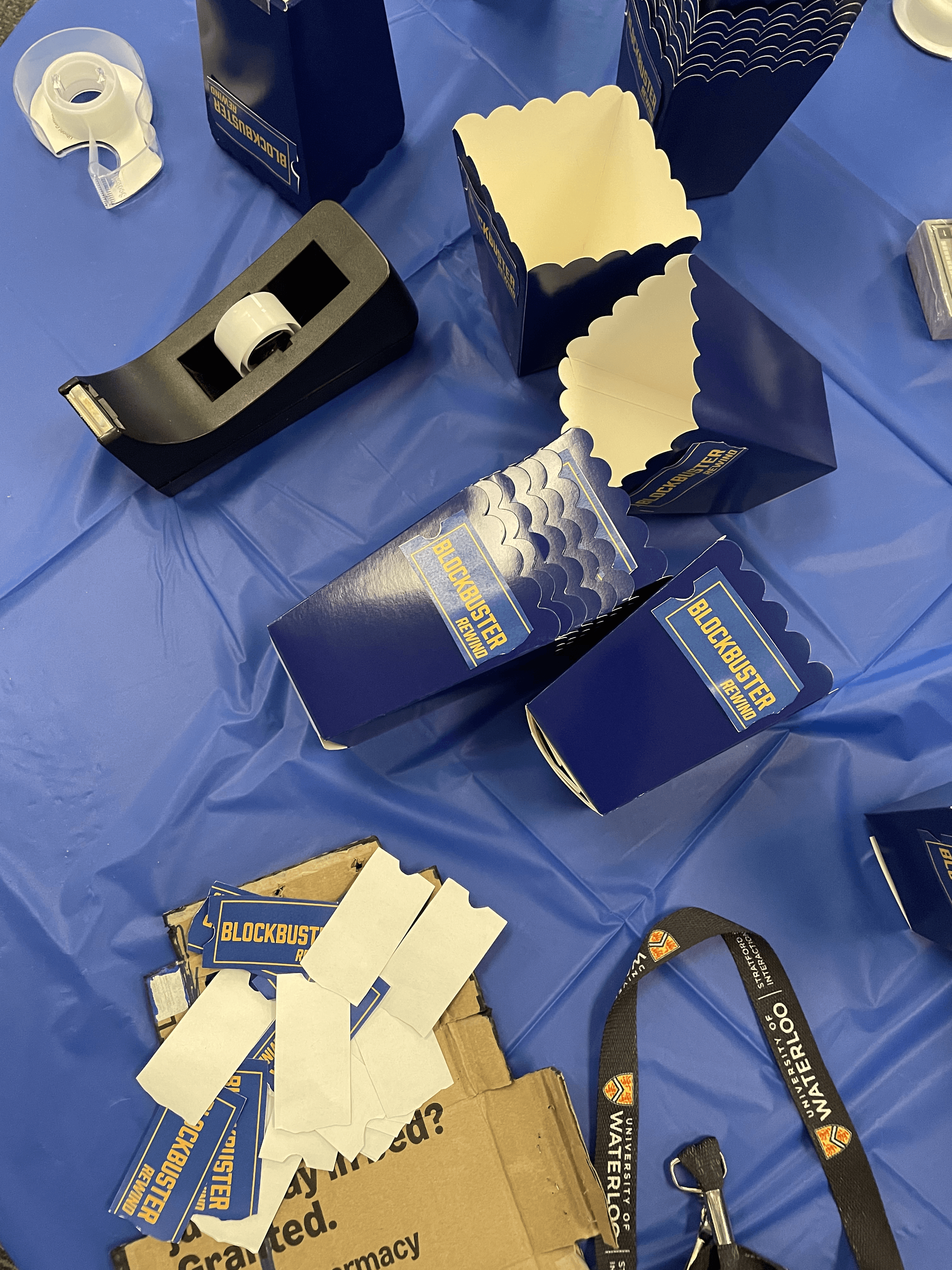
Once the room filled up, the fixes that mattered weren’t in the concept — they were things like moving the Game Master closer to contestants so a barely-audible buzzer didn’t slow the game down.
REFLECTION
What I’d Carry Forward
The biggest lesson wasn’t about trivia or microcontrollers — it was about knowing when to trade an ambitious idea for a feasible one. Swapping a full production for trailers looping on a monitor next to a silent projected film, for instance, turned out to be one of our better decisions, not a compromise.
I’d love to have pushed harder on one open question: whether a room built for hanging out is the right home for something meant to teach.
I pushed hard for a Blockbuster history timeline on the wall, wanting people to actually engage with it. But tucked into a room built for lounging, it never pulled attention the way it would have in a space built for looking. If the goal is for people to learn something, the learning has to be the point of the space — not decoration in someone else’s third place.